

Our post-merger integration consulting practice partners with private, public, and private-equity–backed organizations across industries such as financial services, manufacturing, software, technology, and consumer goods, leading complex integration programs ranging from $50 million to $5 billion in deal value.
As an experienced M&A integration consultant, we work hand in hand with Heads of Integration, Corporate Development leaders, CEOs, COOs, and CHROs throughout the entire integration lifecycle – pre-close planning and Day 1 readiness through hands-on post-close execution.
Our post-merger integration consulting services are designed to ensure a smooth transition with minimal disruption, accelerate value capture, and position the combined organization for long-term success.
Case study
Supported a complex post-merger integration between two large North American financial institutions (approximately CA$5B in deal value), exceeding synergy targets. Provided full Integration Management Office (IMO) support, coordinated 15+ workstreams, implemented structured synergy tracking, and offered hands-on support for change management, target organizational design, HRIS integration, and more, all while maintaining business-as-usual continuity.
Burnie Group’s integration framework
Our post-merger integration consulting is structured around three disciplined phases that ensure strategic alignment, operational readiness, and sustained value realization across the full integration lifecycle.

I. Integration strategy
In the earliest stages of the transaction, we help leadership define the integration ambition and establish the structural foundation required for disciplined execution.
Our M&A integration consulting team works with executive stakeholders to:
- Shape the integration thesis aligned to deal objectives
- Define governance structure and design the Integration Management Office (IMO)
- Structure the synergy approach and value capture roadmap
- Outline the future-state operating model direction
- Define value creation logic and performance metrics
- Identify integration risks and mitigation strategies
This phase ensures that integration is not reactive post-close but strategically anchored before execution begins.
II. Integration planning and day one readiness
With strategy defined, we translate direction into structured, cross-functional planning to ensure a controlled and confident close.
Our integration consulting services during this phase include:
- Developing comprehensive integration plans, including the 100-day roadmap
- Designing Day 1 and interim organizational structures
- Preparing detailed Day 1 closing readiness plans
- Establishing robust integration governance across workstreams
- Implementing structured change management and communication planning
- Developing the high-level integrated target operating model
- Preparing stakeholder communications and leadership alignment
This phase ensures that Day One is operationally stable and strategically aligned, minimizing disruption while maintaining business performance.
III. Execution, value capture and sustainment
Following close, we support hands-on execution across workstreams to deliver identified synergies and transition the organization toward its integrated future state.
Our post-merger integration consulting support includes:
- Detailed execution planning across all functional workstreams
- In-depth assessment of the acquired company’s current state
- Confirmation and tracking of synergy targets and benefit realization
- Development and implementation of the integrated target operating model
- Design and activation of the target organizational structure
- Integration of technology, processes, and channels
- Structured transition from integration governance to business-as-usual operations
This disciplined execution phase ensures that deal value is realized and sustained.
While our Integration Framework provides the strategic structure for successful execution, effective post-merger integration consulting requires disciplined delivery across specific workstreams and functional domains.
To support clients through each phase of the integration lifecycle, we provide targeted M&A integration consulting services across eleven core capability areas, spanning strategy, governance, synergy realization, operating model alignment, technology integration, and change management.
Case study
Supported a cross-border, expansion-driven post-merger integration in which a global German manufacturer acquired a North American filtration products company with operations in the U.S. and Canada. Delivered centralized Integration PMO leadership, developed structured integration plans and executive reporting, and supported target-state design across workstreams, including cross-selling enablement, integrated operating model development, and IT landscape assessment.
When to engage our post-merger integration consulting team
Organizations typically engage us when:
- Extensive integration planning must be developed, both pre-close and post-close
- Day 1 readiness is critical, highly complex, and timelines are compressed
- Synergy realization requires disciplined tracking and executive accountability
- Integration change management is expected to be complex or high-risk
- An integrated target operating model must be designed, spanning organization, processes, technology, and governance
- A non-North American organization is acquiring a business in North America and requires local expertise for on-the-ground integration support
- Integration execution is underway but progressing slowly, putting value capture at risk
- A repeatable, best-practice–based integration playbook is required to support future transactions
Ready to Structure Your Integration for Success?
CONTACT USBurnie Group’s post-merger integration consulting offering
We support your mergers and acquisitions throughout the deal cycle with eleven integration consulting offerings based on our Integration Framework.
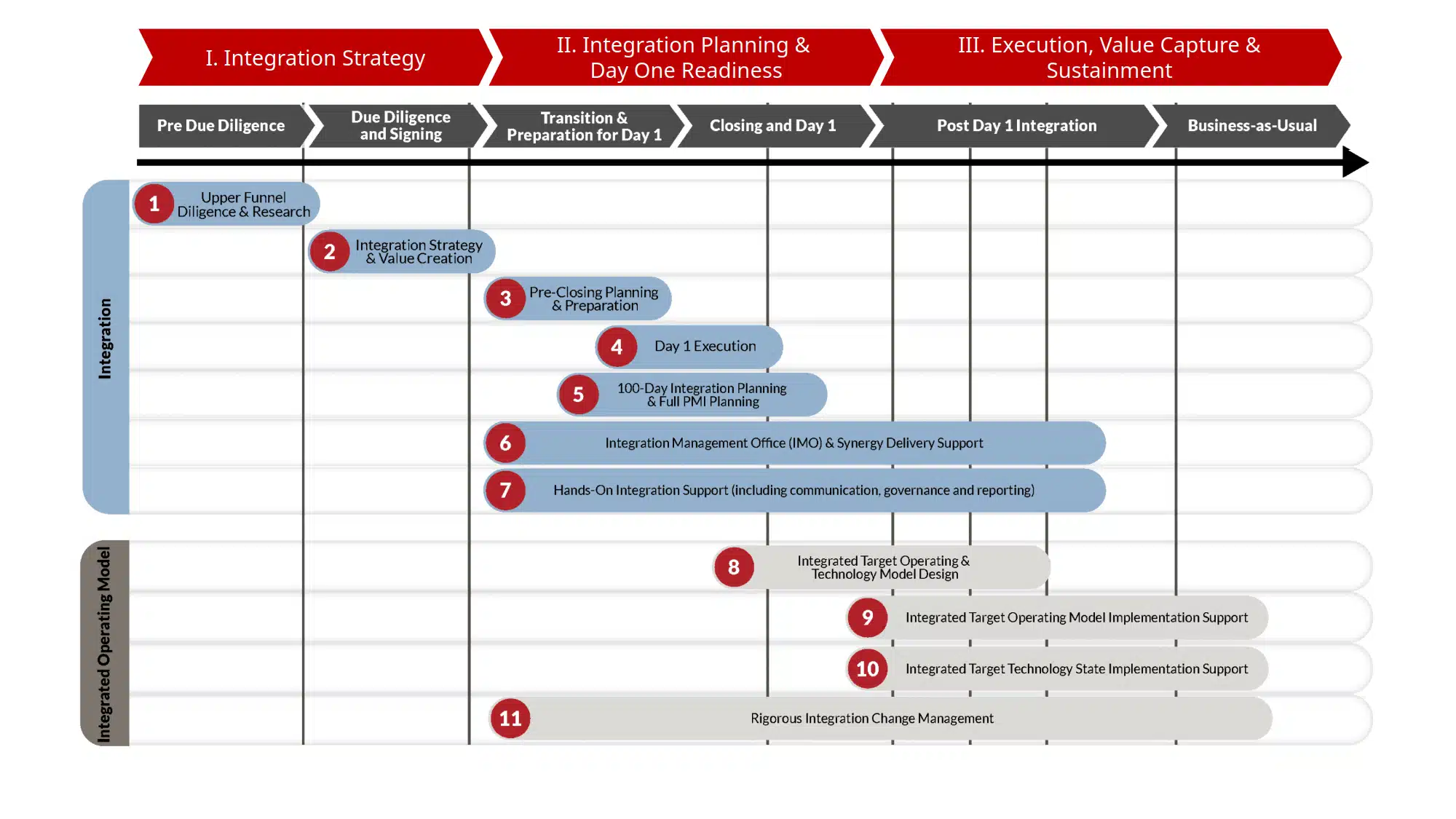
I. Integration Strategy
II. Integration Planning and Day One Readiness
III. Execution, Value Capture and Sustainment
Integration strategy consulting
1. Upper funnel diligence and industry research
We offer upper funnel diligence and sector research as a focused project to understand a target industry, market, and an array of potential acquisitions. These projects lay the ground for a successful acquisition. Our work during this stage includes:
- Upper funnel diligence
- Researching industry segments
- Exploring a sub-sector
- Identifying core capabilities
- Value creation planning
- Scoping potential targets
2. Integration strategy and value creation
We help you develop an integration strategy for your merger or acquisition by clearly identifying the sources of value for the transaction and establishing a foundation to initiate the deal. Our work during this stage includes:
- Identifying the significant sources of deal value
- Developing a post-merger integration strategy
- Developing a data request, such as data storage in a data room
- Identifying core capabilities for each company involved in the integration
- Developing financial deal assumptions and financial models
Integration planning and day one readiness consulting
3. Pre-closing planning and preparation
Our pre-closing planning and preparation include the integration topics that must be addressed before Closing Day and Day 1, such as:
- Developing the governance structure and approach for the integration
- Setting up workstreams and teams to work through the integration
- Designing a high-level integration target state
- Developing integration project plans and charters by workstream
- Setting up the transition service agreements (TSA)
- Designing, preparing, and executing relevant communication
- Establishing integration oversight and reporting
Supporting tools and methodologies:
- Integration Milestone and Activities (IMA) Database
A structured repository of 5,000+ sequenced integration milestones and activities across all workstreams, captured from prior integrations and informed by best practices, designed to simplify and accelerate the development of a comprehensive integration plan.
4. Day 1 execution
A successful Closing Day and Day 1 impact the success of the entire integration, as they are the first impressions of the integrated company. We support you on Closing Day and Day 1 with careful planning and execution, including:
- Identifying all key stakeholders for Closing Day and Day 1
- Developing a step-by-step run-of-play to orchestrate Day 1
- Designing and delivering internal and external communication and welcome materials
- Executing key Day 1 activities, including finance, legal, real estate, and IT
Supporting tools and methodologies:
- Integration Communication Artifact (ICA) Database
A proprietary repository of hundreds of integration communication artifacts, ranging from CEO Day 1 announcements and employee FAQs to customer and vendor outreach materials, enabling consistent, timely, and well-coordinated stakeholder messaging. - Day 1 Run-of-Play Templates
Detailed Day 1 execution plans covering key internal and external stakeholder groups across multiple communication channels, including in-person, email, and virtual formats, to ensure a coordinated and disruption-free close.
5. Post-merger integration: 100-day planning and long-term planning
We help you develop a post-merger integration plan to lay out a clear roadmap for your integrated company’s first 100 days of operations. A thorough plan ensures that all your teams work towards the integrated target state. Our integration planning work includes:
- Developing 30, 60, and 90-day integration plans by workstream, including key milestones
- Leveraging an existing database of integration activities to ensure that no essential items fall through the cracks
- Identifying key decision points throughout the integration
- Identifying and defining interdependence across various workstreams
- Linking integration planning to the operating model and technology re-design topics
Supporting tools and methodologies:
- Integration Milestone and Activities (IMA) Database
6. Integration management office and synergy delivery support
An integration management office (IMO) supports effective and efficient integrations. It is the main point of contact for all integration-related topics, supporting the entire post-merger integration process and providing status updates about integration and value delivery progress. We support your IMO by:
- Facilitating all integration-related touchpoints, capturing and helping to resolve integration questions
- Providing hands-on project management support for all integration workstreams
- Keeping post-merger integration processes on track
- Capturing and delivering integration status reports to senior leadership
- Supporting risk management associated with integration
- Maintaining and updating integration costs and benefits
- Tracking and reporting value captured throughout the integration
Supporting tools and methodologies:
- Executive Integration Reporting Framework
A standardized reporting structure that provides leadership with clear, highly visual, and content-rich integration status updates. - Integration Dependency Management Tool
A robust repository of key cross-workstream dependencies designed to prevent critical sequencing gaps and execution bottlenecks. - Integration Issue and Risk Management Framework
A structured escalation and mitigation framework that proactively identifies and addresses integration risks across all workstreams. - Integration Synergy Tracker
A structured, battle-tested tool designed to capture and track one-time and recurring synergies, associated costs, and required investments across workstreams — aggregating performance across synergy categories (e.g., OpEx, CapEx) to provide enterprise-level visibility into value realization.
Execution, value capture and sustainment consulting
7. Hands-on integration support
We provide post-merger integration support across all integration workstreams by embedding our experienced M&A consultants into your integration teams. Our integration support work includes:
- Embedding additional resources into integration workstreams to support integration activities
- Problem-solving integration issues and suggesting possible solutions
- Providing expert guidance to the workstreams and helping them execute their plans
- Driving cross-workstream communication and collaboration
8. Target operating model design
Designing a target operating model for the integrated organization positions the new unified business for success. Our work during this process involves streamlining the organization, integrating processes, and adopting best practices. Designing the operating model includes:
- Understanding the current operating model, including existing gaps and best practices
- Aligning on the design principles for an integrated operating model
- Planning the target operating model design across all dimensions: people, processes, technology, governance, customer experience, and more
- Developing an implementation roadmap by workstream for an integrated target operating model
An integrated organization might not require a new target operating model if an acquired company folds into existing structures.
Supporting tools and methodologies:
- Visual integrated target operating model design tool
A structured, visual framework used to develop and align senior leadership on interim and target-state operating models across all workstreams, spanning people, processes, technology, and channels. - Integrated organizational design framework
A proprietary organizational design approach that combines quantitative org design analytics with structured stakeholder interviews, scenario modelling, and iterative validation to define and refine the target organizational structure.
9. Target operating model implementation support
Implementing changes post-Day 1 involves implementing the target operating model across all workstreams. We work with you to design your integrated company’s interim and target operating model states with our unique visual methodology. The model reflects customer, people, technology and tools, process, and governance dimensions. This stage includes:
- Re-aligning the integrated company’s organizational structure
- Streamlining and optimizing customer-facing and back-office business and support processes
- Adjusting the integrated company’s physical footprint
- Finetuning the company’s offering, price, and sales approach
- Aligning technology across all IT towers
10. IT integration support
Our IT integration support spans all IT towers: applications, infrastructure, end-user computing, IT security, and IT governance. Our IT support includes:
- Consolidating end-user computing topics, including all devices, IT help desk support, IT in-field support, network, and IT asset management
- Consolidating and optimizing infrastructure, including data centers, server and mainframe landscape, disaster recovery, infrastructure backups, and redundancy
- Aligning support applications, including CRM, HRIS, ERP, GL)
- Aligning core applications
- Streamlining IT support applications
- Streamlining IT governance
- Consolidating end-user computing topics, including all devices, IT help desk support, IT in-field support, and network
Supporting tools and methodologies:
- Integrated IT Landscaping Design
A structured visual methodology used to map and compare key technology platforms, including applications, infrastructure, and end-user computing, across the integrating organizations. The framework surfaces critical IT architecture decisions and informs the design of the integrated target state.
11. Post-merger integration change management
Integrations typically involve significant changes, especially for the people in the acquired organization. We work with you to ensure your leaders plan and drive changes throughout the integrated organization. Our PMI change management work includes:
- Assessing culture and change capabilities across both organizations
- Developing change management plans
- Identifying leaders to drive the change along with internal change agents
- Communicating and cascading the change throughout the organization
- Delivering necessary training and coaching across the organization
- Establishing essential habits and practices to anchor the change
- Monitoring and visualizing the change progress
Supporting tools and methodologies:
- Integration Change Management Planning Tool
A proprietary tool that aligns and tracks all change management–related activities, including communications, leadership alignment, and learning and development initiatives, to ensure structured adoption throughout the integration. - Culture Assessment Survey
A proprietary diagnostic instrument used to evaluate cultural alignment across companies, functions, and leadership teams involved in the integration. - Target Culture Design Approach
A structured methodology to define the desired cultural attributes of the combined organization, aligned with strategic objectives and operating model priorities. - Stakeholder Readiness Assessment
A systematic evaluation of internal stakeholders, including employees and leadership, and external stakeholders, such as customers, partners, and regulators, to assess readiness for change and identify engagement priorities. - Leadership Training and Coaching Program
Targeted executive and management-level development designed to equip leaders with the tools, behaviors, and decision-making discipline required to drive integration success.
Post-merger integration playbook
Some of our clients are in an ongoing acquisition and integration mode, especially in the private equity space. We support clients who face recurring acquisitions by developing a post-merger integration playbook for their organization. We validate our PMI playbooks with our clients in real integrations and align the structure to our post-merger integration framework. A typical merger integration playbook includes:
- Various integration scenarios for different integration types (e.g. size, type, geography, etc.)
- Integration governance
- Typical post-merger integration 100-day plan (including alternative options)
- Integration planning by workstream (e.g. Communication, Sales & Marketing, Product, Legal, Human Resources, Finance, Operations, Technology, and others)
- Operating model re-design approach for an integrated company
- Integration communication samples
- PMI change management
- Integration risk management
- Key artifacts
Case study
Supported one of the largest senior living organizations in the U.S. in designing standardized integration and divestiture playbooks. Led cross-functional workshops to document milestones, ownership structures, key dependencies, and lessons learned, incorporating Burnie Group’s proprietary tools to ensure clarity, accountability, and repeatability. Immediately following completion, applied the newly developed playbook to a live transaction, validating its structure and enabling disciplined execution from Day 1.
Integrating a carve-out
We support our clients through the entire carve-out and divestiture process, both on the integration and selling sides. Integrating a carve-out into an existing operating model involves developing and implementing a Transitional Service Agreement (TSA). Our PMI integration activities and milestones database covers various M&A carve-out scenarios, outlining clear steps for successful execution.
Integrating an M&A roll-up
M&A roll-ups or simple integrations are less complex than full-fledged post-merger integrations. However, they require quick and effective integration. Our rapid integration program supports the most essential integration elements, focusing on the pre-closing and 90-day post-closing phases. After 90 days, all the main operating model elements of your acquired or rolled-up entity are integrated in your existing operating model.
Our post-merger integration differentiators

Our expert team
Our dedicated M&A consultants have extensive PMI experience from top consulting firms. Our team can work with you across multiple integrations instead of switching consultants between engagements. In addition to planning and steering, we roll up our sleeves and get involved with execution tasks.
Integration milestone and activities database
Our database of 5,000+ integration and divestiture activities enables quick, high-level and detailed integration planning. Select the milestones and activities relevant to your deal from our library, spanning industries and functions.
Robust proprietary PMI support tools
Our proprietary tools steer your PMI and track synergies, including dynamic integration worklists, integration reporting, and more. Our proven tools integrate with the tools your organization uses.

Integrated target operating model design
Design your integrated company’s interim and target operating model states with our unique visual methodology. The model reflects customer, people, technology and tools, process, and
governance dimensions.

Robust integration change management, and communication artifact database
Save time and effort with hundreds of proven integration communication templates, including integration principles, overarching integration statements, CEO Day 1 announcements, and employee FAQs.

Hands-on change management support
Our integration support focuses on numerous change management principles to accelerate an integration and guarantee its success. We support your integration through day-to-day involvement and coaching and training of your leaders and teams to ensure a smooth integration.
Ready to Structure Your Integration for Success?
CONTACT USOur insights on post-merger integrations




Client testimonials
"My experience with Burnie Group has been truly exceptional. What differentiates David and his team is their ability and willingness to span from the strategic to execution - in particular, the latter. Burnie Group became indoctrinated in our business, understood our organization dynamics, and was able to both guide the strategic conversation while bringing executional acumen and plugging key gaps as we went through these integrations."
“In the past 4 or 5 integrations, we have not seen a comms/training plan like what you are doing. I can totally see the value in doing this.”
“Burnie Group was very collaborative. They integrated the project lead's input and adapted very well to various stakeholder leads. The team provided thought leadership throughout the engagement. The engagement deliverables were practical and relevant, with excellent augmentation to our executive team.”



Learn about our post-merger integration capabilities.
CONTACT US