

Key takeaways:
- Design post-merger integration (PMI) organizational structure around deal objectives, not legacy structures.
- Ensure Day 1 clarity. Define reporting lines, decision rights, and leadership immediately.
- Prioritize talent retention, protect high performers and critical experts.
- Avoid repeated reorganizations that drive uncertainty and attrition.
- Balance global efficiency with local accountability, especially in cross-border integrations.
- Align metrics and incentives with the new structure. Prevent the organization from operating as two separate companies.
Mergers and acquisitions are among the most complex events in a company’s life. While significant attention is typically devoted to completing the transaction and integrating operations, the organizational structure ultimately determines whether the combined company can function effectively once the deal closes.
Designing that structure is challenging. Leadership teams must make decisions quickly while maintaining day-to-day business performance. These conditions make organizational design both urgent and difficult. The following ten lessons outline practical principles for designing an effective post-merger integration (PMI) organizational structure.
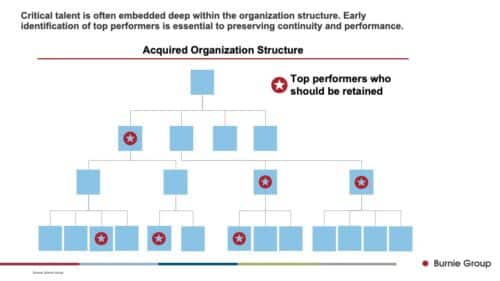
Lesson #1: Identify and retain top performers
Challenge: In many acquisitions, leadership often has limited visibility into who the true high performers and critical subject matter experts are within the acquired organization. This creates a significant risk during the early stages of integration. High-performing employees may feel uncertain about their future in the new organization and may begin exploring opportunities elsewhere. The departure of even a small number of key individuals can create disruption, particularly when they hold critical institutional knowledge, maintain important client relationships, or lead specialized teams. In many cases, attrition can spread further if teams choose to follow trusted leaders who leave.
Recommended Approach: Retention is one of the most important and most time-sensitive elements of organizational design. Before finalizing the structure, leadership should identify individuals who are critical to revenue, business continuity, client relationships, regulatory knowledge, or operational stability. This includes not only executives, but also key subject matter experts whose institutional knowledge may not be visible in an org chart.
When legally permissible, leaders should engage with these individuals early to understand their motivations, career expectations, and potential concerns about the merger. Providing clarity about their future role and growth opportunities in the combined organization can significantly reduce the risk of early departures.
In some cases, organizations may also implement retention incentives, contract adjustments, or other protections that take effect at closing. Taking proactive steps to secure critical talent helps preserve institutional knowledge and maintain business stability during the integration period.
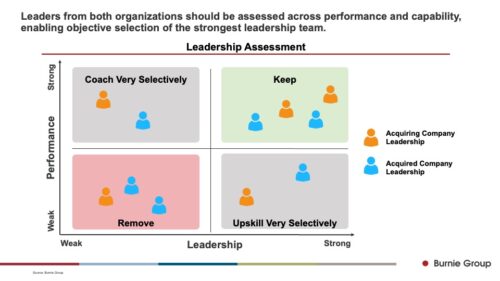
Lesson #2: Assess and select leadership based on capability
Challenge: Leadership appointments after a merger are often influenced by legacy hierarchy or internal pressure rather than objective assessment. Automatically favoring leaders from the acquiring organization may overlook strong capabilities within the acquired company. In reality, the combined organization may have access to a deeper and stronger bench of leaders than either company had on its own. Failing to recognize this can result in missed opportunities to strengthen the leadership team and can create resentment among employees from the acquired organization.
Recommended Approach: Leadership roles should be filled through a structured evaluation of candidates from across both organizations. The goal should be to identify the leaders who are best suited to guide the future direction of the combined company, rather than simply preserving historical titles or reporting structures.
In mergers of equals, visible balance across the leadership team can reinforce fairness and help build trust across the organization. Even in traditional acquisitions, demonstrating openness to leaders from the acquired company strengthens credibility and signals that performance and capability are valued.
Additionally, the scale and complexity of the combined organization may justify the creation of new leadership roles, such as a dedicated integration leader or a head of transformation. Creating these roles can also provide meaningful positions for strong leaders whose previous roles may overlap after the merger.
Lesson #3: Provide Day 1 organizational clarity
Challenge: There is a common expression that you never get a second chance to make a first impression. In a merger or acquisition, Day 1, the day formally operating as one organization, is that moment.
For employees across both organizations, Day 1 often brings significant uncertainty. People naturally wonder how the new company will operate, who they will report to, whether their role will change, and what the future may hold for them. The way leadership communicates and structures the organization on that day strongly shapes employees’ initial perception of the merger.
In the absence of clear vision and direction from the leadership, employees will naturally try to fill the gaps with their own assumptions. Providing clarity on Day 1 helps prevent uncertainty from turning into speculation.
Recommended Approach: Ensure the Day 1 organizational structure is clearly defined and communicated. At a minimum, the top management layers should be established, including reporting lines, decision rights, and governance forums. Employees must know who they report to and how key decisions are made.
It is often unrealistic to finalize the entire organization before closing. In such cases, lower layers may temporarily remain intact while leadership conducts a deeper review. What matters is transparency about this approach. Communicate clearly what Day 1 structure looks like and outline the path toward the target structure, including timelines and decision milestones. Certainty about the process reduces anxiety, even if some details are still being developed.
Lesson #4: Avoid a thousand cuts
Challenge: Some organizations implement multiple rounds of restructuring after a merger as new information becomes available. Each wave of change renews uncertainty among employees, leading to declining morale and increased attrition. Over time, when employees expect that “another reorganization is coming soon,” productivity and stability can quickly decline.
Recommended Approach: Structural changes should be consolidated into as few waves as possible. In many cases, organizations move through three structural stages during integration: a Day 1 structure, a potential interim structure, and the final target organization. The table below shows the typical path to a target org structure for acquisitions of different sizes and complexities:
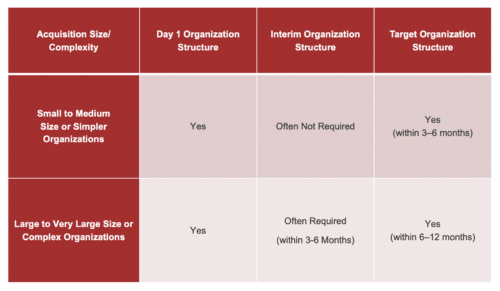
Ideally, move directly from a defined Day 1 structure to a clearly articulated target structure. However, when an interim structure is necessary, it should primarily serve as a management tool, allowing leadership time to evaluate the combined organization. It does not need to be broadly communicated as “temporary” across the company. If employees believe another restructuring is imminent, high performers may leave due to uncertainty about their future roles.
The goal should always be to minimize the number of organizational restructuring “waves” employees experience. During integration, reducing the frequency of these waves is often more important than minimizing the total number of changes themselves.
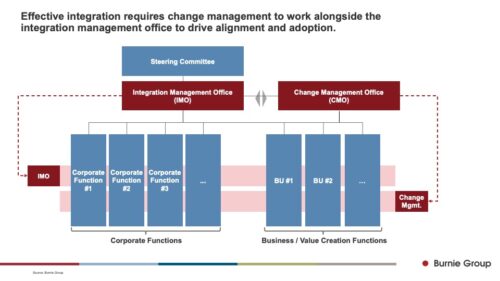
Lesson #5: Treat change management as an integration priority
Challenge: Even a well-designed organizational structure can fail if employees do not understand the purpose of the merger, how the organization is changing, and what the transaction means for them personally. When people lack clarity about the organization’s direction, rumors and speculation can spread quickly. Employees may begin to worry about job security, reporting lines, or potential changes to compensation and responsibilities. If these concerns are not addressed, uncertainty can lead to disengagement, resistance to change, and voluntary departures.
Recommended Approach: Leadership needs to treat communication and change management as a core part of the integration effort. Employees need a clear explanation of why the merger or acquisition is taking place, what the future organization will look like, and how the new structure supports the company’s goals.
Communication should be regular, practical, and consistent. Leaders should provide clear updates on structural decisions, explain the reasoning behind major changes, and openly address common employee concerns. Managers should also be equipped with guidance and talking points so they can discuss these topics with their teams.
When communication is inconsistent or delayed, employees tend to fill the information gap with their own assumptions. Visible and consistent leadership communication helps maintain trust and stability during a period of significant change.
Some organizations go even further. In a recent financial services merger, leadership launched a dedicated intranet site as the central hub for all integration-related updates. The platform became a key tool for maintaining transparency and reducing employee anxiety throughout the process. It was used to publish organizational updates, announce structural changes, roll out new procedures, and host training materials and videos. The site also served as a feedback channel where employees could submit questions and concerns.
In addition to the platform, the organization held monthly company-wide town halls, conducted regular employee pulse surveys, and introduced integration challenges to gamify milestones for teams working on the merger. Together, these initiatives helped reinforce confidence in leadership and sustain employee engagement throughout the integration process.
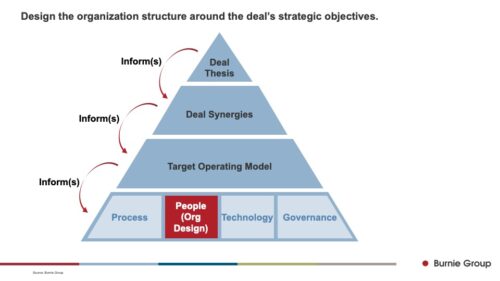
Lesson #6: Design the organization structure around the deal’s strategic objectives
Challenge: After a merger, organizations sometimes default to combining existing structures rather than designing a structure that aligns with the deal’s strategic purpose. When legacy reporting lines are simply merged together, the resulting organization may not fully support the value the transaction was intended to create
Recommended Approach: The organizational structure design should reflect the strategic objectives of the merger or acquisition. Leaders should begin by clearly defining what the deal is intended to achieve and then ensure that reporting lines and functional responsibilities support those goals.
For example, if the transaction is primarily driven by cost synergies, consolidating shared functions such as procurement, finance, or IT may help capture scale efficiencies. On the other hand, if the objective is revenue growth in specific markets, maintaining strong regional leadership and local accountability may be more important.
Every major structural decision should reinforce the transaction’s strategic priorities. If a function remains decentralized despite clear opportunities for scale, or becomes centralized despite requiring local responsiveness, the structure may undermine the deal’s original rationale.
Lesson #7: Consider cultural fit and informal influence networks
Challenge: Organizational charts show formal reporting lines, but they rarely capture how decisions are made within a company. In many organizations, informal networks and long-standing relationships influence how work gets done and how quickly decisions move forward.
When two companies merge, these informal dynamics can differ significantly. If leadership imposes a new structure without understanding how teams collaborate or where influence resides, the result can be friction, slower decision-making, and resistance to new ways of working.
Geography-based cultural differences can also become a major challenge. For example, when a North American filter manufacturing company acquired a German firm, the businesses were strategically complementary but operated with very different cultural norms.
The German organization followed a more structured and hierarchical approach, while the North American company operated with greater flexibility and informality. These differences created friction during integration and led to resistance to new ways of working.
Recommended Approach: When designing the post-merger structure, leaders should consider both the formal organization and the underlying cultural dynamics of the two companies. This includes understanding how decisions are typically made, how teams collaborate, and which individuals hold informal influence within the organization.
Recognizing these patterns helps ensure that the new structure supports effective collaboration rather than unintentionally disrupting it. A structure that aligns with existing ways of working is more likely to be adopted quickly and operate smoothly
Lesson #8: Integrate shared services concept if meaningful
Challenge: After a merger, organizations often retain duplicate support functions for several reasons. Each company brings its own corporate structure, and integration teams may struggle to clearly consolidate overlapping functions. In addition, the merging organizations may operate under different functional models. For example, one company may have a centralized marketing team, while the other relies on marketing teams embedded within each business unit to stay close to local markets and respond quickly.
This misalignment can result in redundant work, inconsistent processes, and missed opportunities to reduce costs or improve efficiency. At the same time, centralizing support functions too aggressively can disrupt teams that depend on specialized expertise or close alignment with business units.
Recommended Approach: Shared services can play an important role in capturing scale benefits after a merger. Consolidating support functions such as finance, HR, IT, or procurement can reduce duplication, standardize processes, and improve efficiency across the organization.
However, these decisions should be made carefully. Some functions may depend heavily on product-specific knowledge, regulatory requirements, or close coordination with business teams. In these situations, full centralization may create operational challenges.
Leaders should therefore evaluate each function individually and determine where consolidation creates value and where localized expertise should be preserved. The goal is to achieve efficiency without disrupting critical operations.
Lesson #9: Account for geography in the organizational structure
Challenge: In organizations that operate across multiple regions, unclear geographic accountability can create confusion around decision-making and ownership. When responsibilities are not clearly defined, teams may duplicate work or provide inconsistent responses to customers, regulators, or partners.
Recommended Approach: Cross-regional mergers require clear geographic accountability. Leadership should explicitly define who is responsible for each country or region, how local teams connect to global functions, and where decision-making authority resides.
Several factors should influence these decisions, including regulatory requirements, market characteristics, and time zone differences. While centralized oversight may improve consistency, excessive centralization can slow decision-making and reduce responsiveness in local markets.
A well-designed organizational structure should therefore balance global coordination with clear regional ownership. When geographic responsibilities are clearly defined, organizations can avoid duplication, resolve decisions more quickly, and maintain strong relationships with local stakeholders.
Lesson #10: Define metrics and accountability for the new organization
Challenge: If legacy performance metrics remain unchanged after a merger, leaders may continue optimizing for objectives that no longer reflect the priorities of the combined organization. This can prevent teams from collaborating effectively and delay the realization of synergies. Even during the integration, efforts may stall if clear milestones and accountability mechanisms are not established.
Recommended Approach: The new organizational structure should be reinforced through aligned performance metrics and incentives. A merger provides an opportunity to review leadership objectives, compensation structures, and key performance indicators to ensure they reflect the priorities of the combined organization. Desired behaviors like collaboration, cost discipline, revenue growth or integration milestones, should be reflected directly in metrics and incentives. If leaders are evaluated based on legacy priorities, the organization will continue to behave as two separate companies.
Defining milestones for the integration process, such as 30, 60, and 90-day targets, can also help maintain momentum and accountability. While reporting lines establish formal authority, performance metrics ultimately shape behavior. Aligning both is essential to making the new organizational structure effective.
Conclusion
Designing the organizational structure after a merger or acquisition is both a strategic and operational challenge. Leaders must make important structural decisions while managing uncertainty, retaining key talent, and maintaining day-to-day business performance.
A well-designed structure provides clarity during a period when employees are looking for direction. It helps protect critical talent, align leadership around shared objectives, and ensure that decision-making remains efficient as the two organizations come together.
The 10 lessons outlined above highlight several principles that can help leaders navigate this process: identifying and retaining strong performers, selecting leadership based on capability, providing clear Day 1 direction, minimizing repeated restructuring, communicating consistently, aligning structure with the strategic goals of the deal, and reinforcing the new organization through clear accountability.
When organizational design is approached thoughtfully, it becomes more than an administrative exercise. It provides a stable foundation that supports integration, enables collaboration across the combined company, and helps ensure that the merger delivers the value it was intended to create.
If you are considering or have recently undergone a merger or acquisition, we would be happy to discuss how our experienced Post-Merger Integration consulting team can add value to your deal and help design your target organization’s structure to ensure a successful integration.
Frequently asked questions
1. What is a PMI organizational structure?
A PMI organizational structure defines how the combined company is organized after a merger or acquisition (Day 1, Interim, or Target), including reporting lines, leadership roles, decision rights, and governance. It ensures the new, integrated organization can operate effectively and capture deal value.
2. What is the best organizational structure after a merger?
The optimal organizational structure after a merger depends on the deal’s strategic goals, such as cost synergies, growth, or market expansion. The structure should be designed to support those objectives rather than replicate legacy models.
3. How do you design an M&A organizational structure?
Designing an M&A organizational structure typically involves:
- Defining strategic objectives of the deal
- Assessing leadership talent across both organizations
- Establishing Day 1 reporting lines and governance
- Designing the target operating model
- Designing the target organizational structure aligned with the target operating model (interim and future state).
- Aligning compensation, incentives, metrics, and accountability with the new structure.
4. When should the PMI organizational structure be defined?
The high-level PMI organizational structure, especially the first 1–2 layers, needs to be defined before day 1 and announced on closing day/day 1 to provide clarity to employees. However, detailed layers of the organization may be refined within the first 3–6 months post-close. In some cases, such as with smaller acquired organizations, the target organizational structure may already be deployed on day 1.
5. What are the biggest mistakes in post-merger organizational design?
Common post-merger organizational design mistakes include:
- Defaulting to legacy structures
- Delaying leadership decisions
- Overlooking cultural differences
- Implementing multiple restructuring waves
- Failing to align incentives with the new structure
6. How does organizational structure impact post-merger integration success?
Organizational structure directly affects decision-making speed, accountability, employee clarity, and efficiency, such as duplication of roles or functions. A poorly designed structure can delay integration, reduce productivity, and limit the realization of synergies.
7. Should companies centralize functions after a merger?
Many companies centralize functions such as finance, HR, legal, or IT to capture efficiencies. However, not all functions should be centralized. Some functions require local or product-level expertise, such as sales, marketing, and customer service, to remain effective. Ultimately, the target organizational structure should align with the overall deal objectives and the target operating model. In some cases, companies may choose to keep the acquired company fully independent.
8. How long does it take to finalize an organizational structure after a merger?
For most integrations:
- Initial structure (day 1): before close
- Target structure: within 3–12 months, depending on complexity
9. What is the difference between the PMI organizational structure and operating model?
The organizational structure defines the people dimension of the operating model, including reporting relationships, organizational sizing, roles, and responsibilities. The operating model spans multiple dimensions and defines how work gets done, including processes, technology, channels, and governance. Organizational structure is therefore a key element of the people dimension within the broader operating model. Both must be aligned for successful integration.
By Alexey Saltykov, Practice Leader, Post-Merger Integrations and Rajveer Singh, Senior Associate.