

Burnie Group partners with senior leaders across North America to redesign organizations in response to growth, M&A, and evolving strategic priorities, delivering practical solutions that drive measurable impact. This includes designing organizational structures, governance models, and decision-making frameworks that enable performance, scalability, and transformation.
What is organizational design?
Organizational design defines how a company structures its people, roles, and decision-making to execute its strategy effectively. It spans organizational structure, governance, and operating model elements such as roles, decision rights, and performance management.
In practice, organizational design is not just about reporting lines. It ensures that:
- the right decisions are made at the right level
- accountability is clear across teams
- the organization can scale efficiently.
When done effectively, it enables organizations to improve execution speed, reduce inefficiencies, and align teams around strategic priorities.
Why organizational design fails in practice
Organizational design challenges rarely stem from a single issue. Instead, they emerge from a combination of structural, governance, and capability gaps.
Common failure points include:
- Structure misaligned with strategy: Organizations often retain legacy structures that no longer support evolving business priorities, resulting in fragmentation and inefficiency.
- Decision rights and governance are unclear: Unclear ownership leads to excessive stakeholder involvement, slow decision-making, and frequent escalations.
- Matrix complexity unmanaged: Without clear interfaces and accountability, matrix organizations introduce duplication, confusion, and inefficiency.
- Too many layers and slow execution: Excessive hierarchy increases cost and slows communication between leadership and frontline teams.
- Misaligned incentives and performance metrics: Teams optimize for local objectives rather than enterprise-wide outcomes.
- Failure to execute change management effectively: Even well-designed structures fail without strong communication, leadership alignment, and adoption support.
- Mismatch between leadership capabilities and organizational complexity: Organizations often evolve faster than their leadership capabilities, resulting in gaps in execution and decision-making.
These issues often manifest as unclear accountability, duplicated work, and slow decision-making cycles.
Discover how our operational support helps solve complex business challenges.
CONTACT USBurnie Group organizational design framework
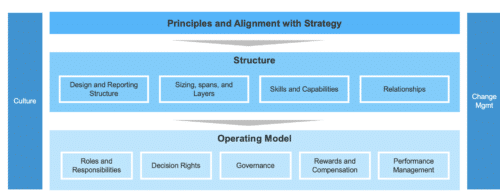
Burnie Group approaches organizational design as an integrated framework that aligns strategy-driven principles, organizational structure, and operating model. These elements are interdependent and rely on culture and effective change management for successful execution.
Design principles and alignment with strategy
Effective organizational design starts with a clear understanding of strategic priorities and business objectives. Design principles guide key decisions and help resolve trade-offs throughout the process.
These principles:
- Focus design efforts on options that support the organizational strategy
- Align executives and senior leadership on key design choices
- Enable the development of a sustainable, forward-looking, high-performing organization
Organizational structure
Organizational structure defines the target organization, including reporting lines, organizational sizing, and associated capabilities.
Design and reporting structure
The choice of organizational structure – such as functional, divisional, matrix, or pod-based – must reflect the organization’s business model, scale, and strategic priorities. Each model comes with distinct advantages, limitations, and trade-offs.
Certain structures are better suited to specific company sizes, industries, geographies, and organizational cultures. It is also important to consider different types of reporting relationships, including solid-line, dotted-line, and informal structures.
Read more about Solving Challenges in Matrix Organization Structures
Sizing, spans, and layers
The number of layers and span of control directly impact efficiency, cost, and decision-making speed. Most organizations tend to add additional layers while decreasing spans of control over time, often requiring detailed analysis to optimize both and remain efficient and effective.
Skills and capabilities
Organizational design must reflect the capabilities required to execute the strategy, including ensuring that leadership and teams have the right skills to operate effectively. This is increasingly important as AI expands the capabilities of both individuals and organizations, enabling new ways of working and reshaping role requirements.
Relationships and interfaces
Many organizational challenges arise not from structure itself, but from unclear interfaces between teams. These interfaces have both a hard and a soft dimension. The hard aspect includes clearly defined roles, processes, and decision points, while the soft aspect reflects how collaboration actually happens in practice, shaped by culture, behaviors, and what is considered “the right way” to work within the organization. Both are critical to ensuring effective coordination.
Operating model
Once the structure is defined, it must be populated to ensure the organization operates effectively. The operating model defines how work is executed and ensures the structure functions without friction.
This requires addressing several critical elements:
Roles and responsibilities
A clear definition of roles and responsibilities is critical to avoiding duplication, eliminating gaps, and ensuring accountability across teams. This is especially important in integration or transformation contexts, where multiple functions, legacy organizations, and decision layers intersect.
Roles and responsibilities should be explicitly defined as part of the broader organizational design, including governance, processes, and decision rights.
Several structured frameworks can be used to define and align roles:
- RACI (Responsible, Accountable, Consulted, Informed):
The most widely used model to clarify who executes, owns, contributes to, and is kept informed on activities. - RASCI (Responsible, Accountable, Support, Consulted, Informed):
An extension of RACI that adds “Support” to better reflect execution in more complex environments. - RAPID (Recommend, Agree, Perform, Input, Decide):
A decision-focused framework (popularized by Bain) that clarifies decision rights, particularly useful in complex or cross-functional organizations.
Decision rights
Establishing clear and effective decision rights is critical to organizational performance, yet is often underestimated in terms of complexity. In practice, defining who makes decisions, how input is gathered, and how conflicts are resolved requires a structured and deliberate approach, particularly in cross-functional or post-merger environments.
Read more about our 5-Step Approach to Resolving Decision Conflicts and Achieving Organizational Alignment
Governance
Governance structures establish decision forums, escalation paths, and oversight mechanisms to ensure alignment and accountability across the organization. More than just a control layer, governance serves as both the glue and the lubricant, holding key organizational elements together while enabling them to function efficiently and cohesively.
Rewards and compensation
Incentive structures must reinforce desired behaviors and align teams with strategic objectives. This includes base compensation, variable incentives, benefits, recognition programs, and other financial and non-financial rewards.
Performance management
KPIs and performance frameworks ensure that the organization is delivering against its objectives and enable continuous improvement. They must be aligned with rewards and compensation and cascaded across organizational levels.
Organizational culture
Organizational culture shapes how decisions are made, how teams collaborate, and how work gets done in practice. It becomes particularly critical during periods of transformation, leadership change, and M&A transactions such as integrations or mergers.
Organizations must understand their existing culture, the behaviors it drives, and how these behaviors support or hinder business objectives. Culture should be explicitly considered in organizational design to ensure alignment with the target state.
Change management
Change management is a critical component of any organizational redesign, transformation, or M&A transaction. It is often underestimated despite its direct impact on implementation success.
It goes beyond communication or training and requires a structured, end-to-end approach that supports alignment, stakeholder engagement, and adoption throughout the transformation.
Organizational design in key business contexts
Organizational design in mergers and acquisitions
M&A introduces significant complexity, requiring alignment of structures, roles, and governance across organizations. Effective design is critical to enabling synergy realization and avoiding integration delays.
Read more about our Post-Merger Integration Checklist: Lessons and Examples from Real Integrations
Read more about PMI Organizational Structure: 10 Lessons from Real Integrations
Organizational design for growth and scaling
Rapid growth increases complexity and often exposes structural weaknesses. Organizations must evolve to maintain efficiency and accountability as they scale operations, expand into new geographies, add products, or transform their business models.
Organizational design for efficiency and cost optimization
Organizations facing margin pressure often redesign structures to streamline layers, optimize spans of control, and shift resources toward higher-value activities. These efforts are typically paired with digitization, automation, and AI enablement to redeploy resources to more value-added work.
Discuss Your Organization Design
CONTACT USHow to execute organizational design
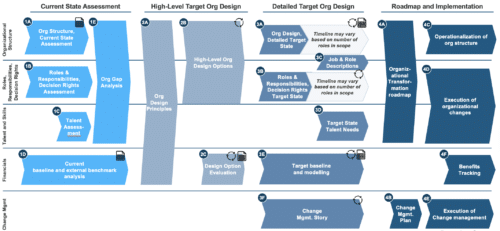
1. Current state assessment
A structured diagnostic builds a fact base across organizational structure, roles, decision rights, and talent. This includes stakeholder interviews, data and document review, and external benchmarking. Key gaps, inefficiencies, and misalignments are identified and validated with leadership.
2. High-level target organization design
Design principles aligned to strategy are defined to guide decision-making. High-level organizational design options are developed and assessed, including structural, governance, and financial implications. Leadership alignment is achieved on the preferred direction.
3. Detailed target organization design
The selected organizational design is translated into a detailed target state, including structure, roles, responsibilities, and decision rights. This phase includes modelling, job and role definitions, and identification of target talent requirements. A clear change narrative is developed to support implementation.
4. Roadmap and implementation
A structured roadmap defines workstreams, milestones, and ownership for implementation. Organizational changes are operationalized, supported by change management and communication. Execution is tracked through governance and benefits realization.
Discuss Your Organization Design
CONTACT USHow Burnie Group supports organizational design
Burnie Group combines senior-led delivery, proven frameworks, and hands-on implementation support to deliver organizational structures that work in practice, not just on paper.
We support organizations with:
- organizational restructuring
- organizational design in M&A contexts, including mergers and integrations
- alignment of organizational design with target operating model design
Frequently asked questions
When should a company redesign its organizational structure?
Organizations typically undertake redesign during periods of change such as mergers, rapid growth, or strategic shifts. Common triggers include inefficiencies, unclear accountability, or misalignment with business objectives.
What does organizational design consulting involve?
Organizational design consulting includes assessing the current structure, defining design principles, developing future-state models, and supporting implementation. It combines strategic thinking with hands-on execution support.
How long does an organizational design project take?
Timelines vary based on scope and complexity. Typical engagements range from a few weeks for targeted redesigns to several months for enterprise-wide transformations.
What are the most common organizational design mistakes?
Common mistakes include focusing only on structure, ignoring decision rights, underestimating change management, and failing to align incentives with the new design.
How is organizational design different from operating model design?
Organizational design focuses on people, roles, and structure, while the operating model defines how work is executed across processes, technology, and governance.


Discover how our operational support helps solve complex business challenges.
CONTACT US